
Todd Blanche’s Conflicts, Part 2

The Senate Judiciary Committee is scheduled to hold a confirmation hearing for Attorney General nominee Todd Blanche, currently serving as Acting Attorney General, on July 15-16.
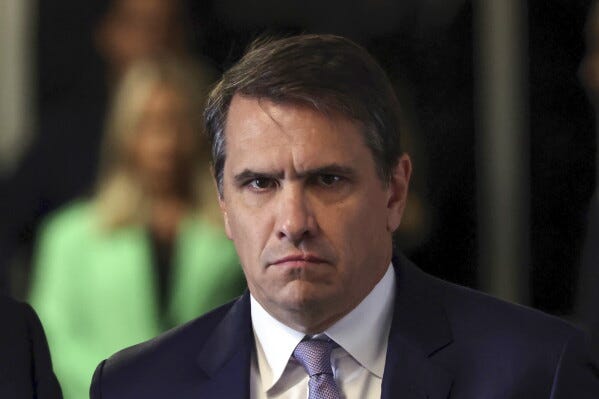
Expect a pretty feisty hearing, particularly since a complaint was recently filed, by two public interest organizations, seeking an investigation of Blanche’s conduct by the First Department of the New York Supreme Court (Blanche’s jurisdiction of admission). Democratic Senators on the committee, and maybe even a couple of the Republican committee members,1 will have questions for Blanche about actions taken under his direction or supervision by the Justice Department, including:
Establishment of a $1.776 billion (get it? – it’s very patriotic and a fitting commemoration of the nation’s 250th birthday) slush fund to compensate people who claim they were targeted by weaponized law enforcement efforts, but only by Democratic administrations.2 The fund was established a part of a settlement agreement between the Justice Department and Trump, his sons, and the Trump Organization LLC, arising out of a claim that the unauthorized disclosure of tax returns by an employee of an IRS contractor had caused damages of $10 billion to the plaintiffs. What would a normal Justice Department, headed by an independent, unconflicted Acting Attorney General do in response to this lawsuit? Presumably explore possible defenses to the action, including most obviously: (i) it was filed after the expiration of the statute of limitations; (ii) the statutory cause of action requires that the unauthorized disclosure be made by an officer or employee of the United States, and the leaker, Charles Littlejohn, was employed by a government contractor, Booz Allen Hamilton; and (iii) the alleged $10 billion damages claim is completely fanciful. And, oh yeah, there’s the problem that Trump is on both sides of this litigation, as a plaintiff in a civil action and the head of the Executive Branch of government. All of these arguments were brought up in an amicus brief filed in the district court by several former government lawyers. But surely an independent, unconflicted, competent senior DOJ lawyer would have recognized and asserted these arguments, right? Another amicus brief, by two watchdog organizations, raised the issue of conflicts of interest for DOJ lawyers, to be discussed further below. Even ordinarily supine Republican Senators reportedly blasted Blanche at a closed-door meeting, citing the blatant self-dealing by Trump as well as the possibility that funds would go to January 6 rioters who had assaulted law enforcement officers. Blanche now says “we’re not moving forward with the fund,” but has refused to put that commitment in writing. A district judge in D.C. had blocked the fund and demanded that Blanche declare under penalty of perjury that the fund was not going forward; the DOJ told her to pound sand. The settlement also drops any pending or future IRS audit against Trump, his family, and his entity, in perpetuity. (The ethics complaint summarizes these events helpfully on pp. 11-19.)
Directing the prosecution of Trump’s political enemies, including former FBI Director James Comey. The New York Times reported that, while Pam Bondi was Attorney General, Blanche advised against pursuing mortgage fraud charges against New York State Attorney General Leticia James, based on information obtained by Bill Pulte, the director of the Federal Housing Finance Agency. Blanche also reportedly advised against appointing Lindsey Halligan as U.S. Attorney for the E.D. Va.; Halligan, of course, left that position after being found to have been appointed unlawfully (see the procedural history in this district court order). Bondi, you’ll recall, was ousted as AG by Trump for not being diligent enough in pursuing Trump’s campaign of retribution. (See my previous post on this.) Blanche clearly got the memo that the next AG had to be a fully committed attack dog against Trump’s enemies, and pushed prosecutors in North Carolina to obtain an indictment of James Comey for posting a picture on social media of seashells on the beach spelling out “86-47” (“86” being common restaurant slang for “we’re out of an item on the menu,” or “throw that idiot out of this establishment.”) Never mind that the statutes under which he was indicted require proof of a subjective intent to communicate a threat and context in which a reasonable person would understand the communication to convey a true threat. And never mind that there is a line of Supreme Court cases holding popping off in the context of political debate is very likely constitutionally protected (see, e.g., Watts v. U.S., 394 U.S. 705 (1969), involving a statement at a public rally that “I am not going [to Vietnam, if drafted]. If they ever make me carry a rifle the first man I want to get in my sights is L.B.J.”). And never mind that conservatives proudly wore t-shirts saying “86-46” when Biden was president (and were not prosecuted for it by the Biden administration). Blanche insisted this was different from those other cases, based on “other investigative steps, or things that we learned, or things that we . . . uncover from talking to witnesses.” Sure, just like the AUSA in Chicago who keeps telling grand jurors that they should trust her, because she has all the evidence that the defendant is guilty. Even conservative legal commentator Andrew McCarthy called the charge “absurd” and said it was “ridiculous” to believe that Comey intended to communicate a true threat of violence with his seashell picture.
Directing the Justice Department to investigate Democratic political officials in Minnesota who opposed to militarized deployment of federal law enforcement officers to Minneapolis, in the so-called “Metro Surge” operation. District judge Patrick Schiltz (a very conservative judge, by the way, and a former clerk for Justice Scalia - not someone who can be dismissed with the usual Trumpian rhetoric of being a “radical left lunatic”) granted a motion to quash investigative subpoenas, on the ground that “the subpoenas were issued as part of an unconstitutional effort to coerce Minnesota officials into assisting the federal government with enforcing civil immigration laws and to harass and retaliate against them for failing to do so.” Judge Schiltz cited “overwhelming” evidence that the subpoenas were issued for unlawful purposes, including “a media appearance by then-Deputy Attorney General Blanche suggesting that the “governor” and “mayor” – that is, the officials who were most closely tied to the two leaked subpoenas -- may have committed federal crimes.” As Judge Schiltz noted, the campaign of intimidation against Minnesota state officials “played out against the backdrop of the Trump administration’s well-established history of using criminal investigations to retaliate against and pressure the President’s political and personal adversaries.” The judge also cited a public statement by Blanche accusing the Governor of Minnesota and the Mayor of Minneapolis of “encouraging violence against law enforcement” and stated that he would stop their “terrorism by whatever means necessary”; to this the judge added a footnote indicating that Blanche’s statement was in response to a report of an assault on an ICE agent that was later discovered to have been fabricated.
Conflicts in the Broad Sense: Prosecutorial Neutrality
As frequently observed in all of the discussion of regulation of federal government lawyers, the legal profession in the United States is regulated by state judiciaries. The DOJ has a new rule attempting to insert the Attorney General into the process of disciplining federal government lawyers, and the government has recently sued the D.C. Board of Professional Responsibility for moving to disbar former DOJ lawyer Jeffrey Clark. But none of this changes the ultimate source of professional regulation, which is the inherent authority of state courts.
I mention state court regulation, because when talking about the duties of prosecutors, lawyers love to refer to a 1940 speech by Attorney General Robert Jackson, in which he says:
If the prosecutor is obliged to choose his cases, it follows that he can choose his defendants. Therein is the most dangerous power of the prosecutor: that he will pick people that he thinks he should get, rather than pick cases that need to be prosecuted In such a case, it is not a question of discovering the commission of a crime and then looking for the man who has committed it, it is a question of picking the man and then searching the law books, or putting investigators to work, to pin some offense on him.
The ethics complaint with the First Department cites this speech on p. 5. It’s great, and there are few former Attorneys General who are more widely respected than Robert Jackson, but it’s important to see that this was not just one lawyer pontificating at a public occasion (in this case, the Conference of U.S. Attorneys), but rather the principles stated by Jackson are deeply woven into the law with respect to government lawyers.
Take an example from the California Supreme Court, People ex rel. Clancy v. Superior Court, 705 P.2d 347 (Cal. 1985). The case arose out of a determined effort by a city government to get rid of an adult bookstore. The city ended up hiring a private attorney to bring an action against the bookstore as a public nuisance. The Supreme Court’s decision was mostly about the permissibility of paying the private attorney on a contingent fee basis (the court said nope), but more important for our purposes
[A] prosecutor’s duty of neutrality is born of two fundamental aspects of his employment. First, he is a representative of the sovereign; he must act with the impartiality required of those who govern. Second, he has the vast power of the government available to him; he must refrain from abusing that power by failing to act evenhandedly. These duties are not limited to criminal prosecutors: “A government lawyer in a civil action or administrative proceeding has the responsibility to seek justice and to develop a full and fair record, and he should not use his position or the economic power of the government to harass parties or to bring about unjust settlements or results.” [Citing EC 7-14 of the 1969 ABA Model Code of Professional Responsibility.]
705 P.2d at 350-51. The duty of neutrality is important because the prosecutor’s job often involves a balancing of interests:
[T]he abatement of a public nuisance involves a balancing of interests. On the one hand is the interest of the people in ridding their city of an obnoxious or dangerous condition; on the other hand is the interest of the landowner in using his property as he wishes. And when an establishment such as an adult bookstore is the subject of the abatement action, something more is added to the balance: not only does the landowner have a First Amendment interest in selling protected material, but the public has a First Amendment interest in having such material available for purchase. Thus, as with an eminent domain action, the abatement of a public nuisance involves a delicate weighing of values.
705 P.2d at 352.
The last time I wrote about Todd Blanche and conflicts of interest was in connection with Blanche’s meeting in prison with Ghislaine Maxwell, apparently in an effort to get her to say that Trump did not have as close a relationship with Jeffrey Epstein as it may appear. In that post I talked somewhat indirectly about the duty of neutrality. I put the observation in terms of the identity of the client of a government lawyer. The client of Todd Blanche, then Deputy Attorney General, is the United States of America, most definitely not Donald Trump. Yes, the president gives direction to the Attorney General and subordinate government lawyers down the chain of command, but the president has an independent obligation to take care that the laws of the United States be faithfully executed, and in any event the president is also acting in a representative capacity, as an agent of the United States. The ethics complaint against Blanche echoes this analysis when it states that “Mr. Blanche failed to competently and diligently represent the United States” (emphasis added).3 And it emphasizes on p. 35:
As Acting Attorney General, Mr. Blanche is under an obligation to serve the interests of the United States and not Donald Trump. Where those two interests conflict, Mr. Blanche’s responsibility is to the nation and not to the President.
Conflicts in the Narrow Sense: Interference with Professional Judgment
This observation sets up the analysis of Blanche’s conflicts of interest, in connection with Ghislaine Maxwell and also the episodes described above. As the passage from the California Supreme Court case shows, the basic duty of a prosecutor is to exercise judgment among competing interests, to make a decision about what is in the best interests of the client, the sovereign, which itself has fiduciary duties to the members of the polity.
A lot of commentary about the nomination of Todd Blanche as AG refers to him as “Trump’s former personal lawyer.” Blanche was on Trump’s legal team in connection with the January 6 investigation, the Mar-a-Lago documents case, and the New York State hush-money prosecution; he also represented key Trumpworld figures like consigliere Boris Epshteyn and former campaign chair Paul Manafort (see p. 8 of the ethics complaint). The question is, what is the significance, in terms of the rules of professional conduct, of this relationship? It’s important to get this right, because not all former Trump lawyers should be treated the same.4
The ethics complaint against Blanche cites the successive conflicts rule, N.Y. Rule 1.9(a), and the rule on moving from private practice to government service, N.Y. Rule 1.11(d). These rules state the following principle (see p. 32 of the ethics complaint):
Pursuant to Rule 1.9 and Rule 1.11(d)(1-2), Mr. Blanche may not represent the government “in the same or a substantially related matter in which that person’s interests are materially adverse to the interests of [a] former client unless the former client gives informed consent, confirmed in writing.”
But I think a different provision of the rules, considered later in the ethics complaint (p. 35), better captures the essence of Todd Blanche’s conflict:
Except [with informed consent, confirmed in writing, and assuming the conflict is consentable] a lawyer shall not represent a client if a reasonable lawyer would conclude that the representation involves a concurrent conflict of interest. A concurrent conflict of interest exists if . . . (2) there is a significant risk that (i) the lawyer’s independent professional judgment on behalf of a client will be adversely affected by, or (ii) the representation of one or more clients otherwise will be materially limited by, the lawyer’s responsibilities to another client, a former client or a third person or by the lawyer’s own financial, business, property or other personal interests.
N.Y. Rule 1.7(a)(2). This way of looking at Blanche’s conflict links the language of the rules with the policies they are meant to serve. That policy is the one stated in the California Supreme Court case: A government lawyer must be unencumbered by loyalties to other current clients, loyalties to former clients, or personal financial or other interests, so that a reasonable observer may fairly be assured that the lawyer will refrain from abusing government power to “harass parties,” “bring about unjust settlements or results,” or be unable to engage in the balancing of interests that is required by the role.
As I am constantly reminding students, conflict of interest rules are “risk rules.” The substantive requirement of the rule – that the lawyer not undertake a representation if there is a conflict of interest – and the judicially created remedy of disqualification for conflicts of interest, do not require a showing of actual harm to a current or former client, or actual interference with the attorney’s professional judgment. “No harm, no foul” may be part of pickup basketball, but it is not a principle of the law of lawyering. The rules do require that there be a significant risk of interference with the lawyer’s independent professional judgment, but the significance of the risk has to be assessed in context. Maybe at the time of his confirmation hearing to serve as Deputy Attorney General it was not clear whether Blanche would permit his independent professional judgment to be adversely affected by his loyalty to Donald Trump. He was a bit . . . lawyerly? in response to the Senate Judiciary Committee’s question about recusal for conflicts:
Question: Given your role in personally representing several individuals being investigated or prosecuted by the Justice Department, will you commit to actually following the advice of career DOJ ethics officials when addressing conflicts of interest?
Response: In the event of any potential conflict of interest, I will consult with the appropriate Department of Justice ethics officials and act consistent with governing regulations.
As former White House Counsel Bob Bauer observed,
Blanche did not commit to abiding by the counsel of “appropriate Department of Justice ethics officials,” only to “consult with them.” He did not pledge to comply with existing ethics rules, only to “act consistent with” them – whatever he might have meant.
The Senate let that ride the first time, but now there is a shit-ton of evidence that Blanche will not comply with ethics rules. We don’t need to speculate, based on evidence like Blanche’s fulsome statements of loyalty to Trump (“I respect President Trump and consider my representation of President Trump to be the highlight of my professional life and an honor that I will cherish until the day I die”) or entrenched political beliefs (see ethics complaint, pp. 35-36). All the evidence is out there, in the three episodes described above, among others.
As I tell students, the way to understand conflicts of interest is to start with what a hypothetical independent, unconflicted lawyer would do. Then look at the relationships with or responsibilities to current or former clients, third parties, or the lawyer’s own interests. Is there a significant risk that the lawyer’s representation will deviate from the hypothetical baseline? If yes, then there’s a conflict.
Go through that here: Imagine a hypothetical senior government lawyer, with no connections or loyalties whatsoever to Donald Trump, reviewing the lawsuit against the IRS. Would that lawyer advise the line-level DOJ lawyers handling the case not to move to dismiss based on the statute of limitations and failing to sue the proper party? Would that lawyer simply accept at face value a damages claim in the billions of dollars? Would the lawyer agree to throw into the settlement a lifetime immunity from tax audits? Of course not! This isn’t a hard call. The only explanation for Blanche’s conduct in connection with the IRS litigation is such overwhelming loyalty to Trump personally (a third party or former client interest), or else the desire to remain in Trump’s good graces and become Attorney General (a personal interest), that causes Blanche’s independent professional judgment to go haywire.
The same is true for the Comey indictment for the seashells. An independent, neutral, sober, fair-minded consideration of a social media post, by the former Director of the FBI, using a common slang term for “throw the bum out,” taking into consideration First Amendment cases like Watts v. U.S., would never conclude that probable cause exists to seek an indictment for making a threat of violence against the president. If you read this and doubt that there is such a thing as an independent, neutral, sober, fair-minded perspective on events, we have a different problem; you doubt that there can be an objective perspective on any legal question. Granting the most moderate degree of objectivity and neutrality, however, it is hard to see how the DOJ’s pursuit of Comey for an alleged assassination threat is the result of anything other than a disqualifying conflict of interest by Blanche.
On the third case, don’t take my word for it. There is a very high standard for quashing an investigative subpoena. “Traditionally the grand jury has been accorded wide latitude to inquire into violations of criminal law.” U.S. v. Calandra, 414 U.S. 338 (1974). A grand jury subpoena is presumed to be reasonable. But if the dominant purpose for issuing a subpoena is improper, such as initiating an investigation out of malice or an intent to harass, a court may grant relief. As Judge Schiltz concluded, on the basis of “overwhelming” evidence, these subpoenas were improper:
Initiating a criminal investigation in order to harass political opponents or to coerce them into taking official action-particularly official action that the federal government cannot directly require those political opponents to take-is a blatantly unlawful and unethical use the grand-jury process.
He noted that the DOJ “has struggled – without success – to identify a single plausible investigatory justification for the subpoenas.” So ask yourself: Would an independent, neutral government lawyer have approved those subpoenas? If the answer is no, then the conflicts analysis is clear.
I don’t know what the First Department will do with the disciplinary complaint. I’m pretty sure I know what the Senate will do. A few Republican Senators occasionally discover a spine, but then seem to lose it again at crucial moments (looking at you, John Cornyn). But for the sake of making a complete record and, hopefully, correcting the abuses of the Trump administration under a different president in the future, it is useful to document violations of the rules of professional conduct by senior government lawyers. I’m grateful to the drafters of the ethics complaint for doing an excellent job at that. Good stuff in there for PR teachers, too!
Texas Senator John Cornyn was targeted by Trump, who endorsed state AG Ken Paxton in the Republican primary, with Trump saying that Cornyn “was VERY disloyal to me.” Cornyn’s offense? Apparently only having made the remark, in May 2023 when Trump was contemplating a second run for president, that “Trump’s time has passed him by. I don’t think President Trump understands that when you run in a general election, you have to appeal to voters beyond your base.” Paxton trounced Cornyn in the primary. North Carolina Senator Thom Tillis, who is retiring at the end of his term, had previously blocked the nomination of Kevin Warsh as fed chair until the Justice Department dropped its criminal investigation of Jay Powell. Tillis recently said, however, that he has a “positive predisposition” toward Blanche’s confirmation.
You have to read carefully to pick this up. Section V.C of the Settlement Agreement states that, to be eligible for compensation, a claim must state that the claimant was a victim of Lawfare and/or Weaponization. This term is defined in the recitals in Section II.C as “the sustained use of the levers of government by Democrat elected officials, political and career federal employees, contractors, and agents in order to target individuals, groups, and entities for improper and unlawful political, personal, and/or ideological reasons.” (h/t the Serious Trouble podcast for pointing this out.)
The ethics complaint also pitches its objection to Blanche here in terms of the duties of competence and diligence, under Rules 1.1 and 1.3 of the New York Rules of Professional Conduct. “Even a modestly diligent attorney would have raised some defense” to Trump’s lawsuit against the IRS, it argues (p. 21). That may be right, but the explanation for the failure to assert the statute of limitations, argue that the leaker was not a U.S. government employee, etc., is likely not incompetence or laziness. Rather, it is manifestly favoring Trump’s personal interests over the interests of the United States, which is a conflict of interest. Charging this as a competence and diligence violation kind of misses the point. The point is not that Blanche is a dummy, but that he is corrupt.
For example, Sullivan & Cromwell partner Matthew Schwartz has been nominated to the Second Circuit and his nomination was voted out of the Judiciary Committee. He and his firm are working on the appeal of Trump’s conviction in New York State court for falsifying business records to conceal hush money payments to Stormy Daniels. Beyond that prior representation, and generally conservative credentials (such as having clerked for Justice Alito), there seems to be no evidence that he will have the same tendency as Blanche to favor the personal interests of Trump over the duties of his role as an appellate judge.
Terrific post with great analysis