
Resignation and Integrity

The Washington Post is reporting [gift link] that prosecutors in the U.S. Attorney’s Office in the District of Minnesota are considering resigning (have threatened to resign?) en masse out of frustration – which seems like a weak word; profound moral objection would be better – with the Justice Department’s response to the killings by ICE officers of Renée Good and Alex Pretti. The Post reports:
The U.S. attorney’s office in Minnesota has been in turmoil since the administration sidelined the office in the investigations around the shootings of Good and Pretti, who were shot 2½ weeks apart during confrontations with immigration officers in Minneapolis.
At least a half-dozen prosecutors in the office — including the second-in-command — resigned earlier this month after top Justice Department officials told prosecutors not to investigate the shooting of Good but instead try to build a case against her partner.
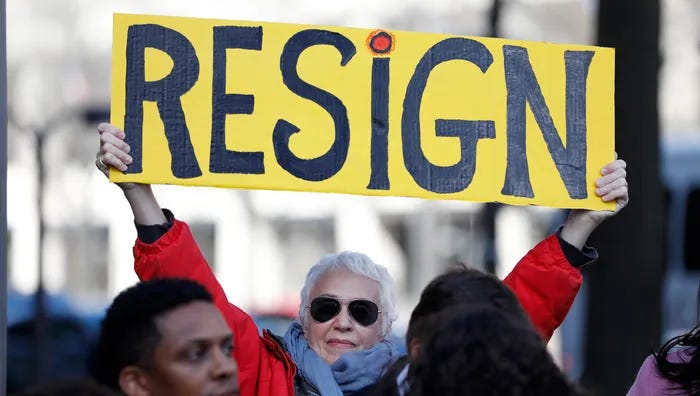
The New York Times reports [gift link], as part of its story on the arrest of journalist Don Lemon at a protest, that the resignations were due in part to the DOJ’s refusal to investigate the conduct of ICE and CBP officers:
At a tense meeting earlier this week, a number of prosecutors challenged the head of the office about the administration’s decision not to pursue investigations of the shootings by federal agents, according to people familiar with the internal discussions. At least a half dozen prosecutors have resigned, and more departures are expected.
In response, a DOJ spokesperson cited AG Pam Bondi’s “zealous advocacy” memo, which concluded:
It is therefore the policy of the Department of Justice that any attorney who because of their personal political views or judgments declines to sign a brief or appear in court, refuses to advance good-faith arguments on behalf of the Administration, or otherwise delays or impedes the Department’s mission will be subject to discipline and potentially termination, consistent with applicable law.
Resignation or threats of resignation to adhere to public purposes
In the stark terms of the Bondi memo, these prosecutors are apparently unwilling to do their jobs, so they might as well hit the bricks. But the ethical issues raised by resignation in protest of unjust official action is a lot more complicated than that. For one thing, a lot is riding on the definition of “do your job.” As I’ve written here, Bondi’s memo omits the crucial second part of the shopworn maxim, “zealous advocacy within the bounds of the law.” In that same post I explained that many of the ethical obligations of lawyers generally, and prosecutors in particular, do not come down to “personal political views or judgments.” Decisions about whom to investigate and prosecute are areas in which federal prosecutors are vested with great deal of discretion. But it is a mistake to think any exercise of that discretion must come down to purely personal political views. The ABA Criminal Justice Standards for the Prosecution Function lists a number of factors that should be taken into account when making decisions about initiating or maintaining criminal charges:
(i) the strength of the case; (ii) the prosecutor’s doubt that the accused is in fact guilty; (iii) the extent or absence of harm caused by the offense; (iv) the impact of prosecution or non-prosecution on the public welfare; (v) the background and characteristics of the offender, including any voluntary restitution or efforts at rehabilitation; (vi) whether the authorized or likely punishment or collateral consequences are disproportionate in relation to the particular offense or the offender; (vii) the views and motives of the victim or complainant; (viii) any improper conduct by law enforcement; (ix) unwarranted disparate treatment of similarly situated persons; (x) potential collateral impact on third parties, including witnesses or victims; (xi) cooperation of the offender in the apprehension or conviction of others; (xii) the possible influence of any cultural, ethnic, socioeconomic or other improper biases; (xiii) changes in law or policy; (xiv) the fair and efficient distribution of limited prosecutorial resources; (xv) the likelihood of prosecution by another jurisdiction; and (xvi) whether the public’s interests in the matter might be appropriately vindicated by available civil, regulatory, administrative, or private remedies.
Agree or disagree with any of these factors or their application to a particular case, there is no necessary relationship between any of them and the “personal political views” of a prosecutor. These are objective standards, in the sense that they refer to considerations beyond the interests, views, or preferences of any particular prosecutor.
Granted, standards for the exercise of discretion are not self-applying. (Gratuitous Wittgenstein/Kripke reference: No rule can determine the scope of its own application.) Different prosecutors looking at the same laundry list of factors may decide differently about whether to pursue an investigation or criminal charges. In a classic 1973 article, Richard Uviller argued that prosecutorial discretion should be “guided by an honest effort to discern public needs and community concerns than by personal pique or moralistic impertinence.” Tough to disagree with that. Importantly, however, Uviller sees no alternative to reliance on the rectitude of the legal officials who administer the law:
Let us frankly acknowledge that justice in the criminal process and the rectitude of its administrators are both largely a matter of myth. (I use myth in the anthropological sense, as a community belief which, whether true or not, is necessary for the functioning of some institution of that community.) We need faith in our legal institutions, and it helps to define the nature of our expectations. Whether the precision and accuracy of that definition can contribute to its realization is, of course, a matter of the most theoretical speculation. But is it not conceivable that by stating the nature of our demand with care we may encourage the institution to respond along the same beam? Essentially, then, I am neither seeking to conceal the weaknesses of the structure beneath a gloss of pious mythology, nor am I confident in the expectation that formulation produces compliance. Rather, I hope here only to describe what I believe to be the root of ethical comportment. And if it be said that prosecutors claim to be moved in the exercise of their discretion by public purposes only, then I am less concerned with detecting their deception than I am gratified to discover that the rationalization evidences adherence to the precept that public compassion, not private moralism, counts.
Resignation, whether individual or en masse, may therefore be understood as a way of maintaining a community belief in the functioning of our institutions. Justice in that functioning depends on prosecutors having the appropriate motivations – being “moved in the exercise of their discretion by public purposes only” – and there may be cases in which an ethical prosecutor has no option but to resign.
As an example of how this may work, consider the threat of several senior DOJ officials in the first Trump administration to resign if Trump appointed Jeffrey Clark as acting Attorney General. Clark, along with John Eastman, had prepared memos detailing a pathway for Vice President Mike Pence to refuse to certify the 2020 election results. Trump reportedly said to acting Attorney General Jeffrey Rosen,
“Well, one thing we know is you, Rosen, you aren’t going to do anything. You don’t even agree with the claims of election fraud, and this other guy at least might do something,” referring to Clark.
After a “heated discussion,” Rosen stated that he would resign immediately if Clark were appointed as acting AG, and numerous other senior DOJ lawyers would as well. As recalled by acting DAG Richard Donoghue:
“Within 24-48-72 hours, you could have hundreds and hundreds of resignations of the leadership of your entire Justice Department because of your actions. What’s that going to say about you?” Donoghue remembers asking.
This threat by government lawyers to resign had a significant stabilizing effect on the chaotic efforts by numerous Trump advisors to certify alternate slates of electors with a view toward overturning the election of Joe Biden.
This is a matter of “ethics beyond the rules” or a constructive normative account of the obligations inherent in a professional role, but it still isn’t personal in the way Bondi’s memo suggests. Her memo states:
The discretion afforded Department attorneys entrusted with those responsibilities does not include latitude to substitute personal political views or judgments for those that prevailed in the election.
But this misses the point. A prosecutor threatening to resign to further the public purpose of the role would be acting to reorient the office or the department to what its proper purpose should be, rather than merely acting on the basis of personal political views.
Resignation as an integrity-preserving technique
There appears to be no room for this kind of ethical decisionmaking in Pam Bondi’s vision of the function of federal government lawyers. Her “zealous advocacy” memo is characterized by the familiar Trumpian tone of aggression and fealty to the president. Arguably, however, she might respond that she agrees entirely with Uviller that prosecutors must be moved exclusively by public purposes, but that the substantive content of those public purposes is determined by the president. In that case, resignation might be understood differently. Rather than as a technique internal to a professional role – part of the normative toolkit that can be employed by an ethical prosecutor – resignation could be understood as a way of preserving the appropriate connection between the professional role and broader moral considerations. In other words, it would be a device for protecting the integrity of people acting in a professional capacity.
There is surprisingly little scholarship in the field of practical and professional ethics on resignation. The leading article is still a 1999 paper by J. Patrick Dobel, called The Ethics of Resigning. Dobel conceptualizes resignation as primarily a way to safeguard one’s personal integrity. This is an alternative to two standard views about the decision to stay in a job or quit when the job appears to involve wrongdoing:
Better for a good person to stay in the position and try to improve things rather than resigning, which would result in the position being filled by someone with fewer scruples. (But then what if you’re that good person? Do you just keep your head down and try not to get fired? If you actually try to change things, you’re going to be out on your butt. If you don’t try to change things, however, what’s the use of staying in?)
A threat to resign, or actual resignation, should be contemplated only when it seems likely that it will result in a change in the policy or practices of the institution. (This would be analogous to civil disobedience in other areas of political life. It’s a highly visible, communicative act, intended to signify that things have gone seriously haywire in the government. Back to the Uviller point, it’s a big red flag to the public that the type of conscientious professionals we rely upon to uphold the public purpose of institutions no longer have confidence that their bosses care about the public purpose of the institution.)
Notice that both of these views link the ethics of resignation to outcomes. As such, they run into the problem of moral luck, which makes the assessment of agents subject to factors beyond their control. We don’t want to say that Rosen, Donoghue, and other senior DOJ lawyers in the first Trump administration acted rightly because they thwarted the Clark/Eastman election-interference scheme.
That’s not to say that resignation may not be used successfully in a strategic way. After breaking the story of the possible mass resignation by D. Minn. prosecutors, the Washington Post subsequently reported [gift link] that the Justice Department was opening an investigation into the shooting of Alex Pretti. But the ethics of the decision to resign is best analyzed independently of the consequences of resignation.
Dobel’s article on resignation understands its importance in connection “the moral ecology of the self”:
Personal integrity matters because it enables persons to claim life as their own and enables society to allocate responsibility on the assumption that individuals can act with consistency and discipline on behalf of promises. Personal integrity involves the capacity to take a reflective stance toward roles and actions, and make sense of how they cohere.
People frequently act within social and institutional roles. Legal ethicist Tim Dare is one of the leading theorists of role morality. He defines roles as follows:
[W]hen we speak of roles, we will mean positions in social networks that bring with them specific sets of moral obligations that attach to those who come to occupy the positions. To say that a role-obligation “attaches to a role-occupant” is to say that it applies to an individual in their capacity as, and by virtue of, their status as an occupant of that role.
The problem of integrity arises when one of these role-obligations conflicts with what one otherwise has reason to do or refrain from doing, whether because of the sorts of moral considerations that would apply to simply being a human being, or because of another role, commitment, or loyalty of the agent. An example of a serious integrity problem comes from one of my all-time favorite legal ethics article – David B. Wilkins, Race, Ethics, and the First Amendment: Should a Black Lawyer Represent the Ku Klux Klan?, 63 Geo. Wash. L. Rev. 1030 (1995). The Black lawyer in the title was Anthony Griffin, a civil rights lawyer who served as the general counsel for the local branch of the NAACP:
Griffin accepted the representation of a leader of the local Ku Klux Klan. The Klan had been engaged in a campaign of terror directed against Black residents who had moved into a housing project under a federal desegregation order. The Texas Civil Rights Commission, seeking to prosecute Klan members who had threatened the Black residents, sought discovery of the Klan’s membership list. Griffin, recalling the Supreme Court’s protection of NAACP membership lists when they were sought by segregationist Southern government officials during the civil rights movement, agreed to represent the Klan and its leader in the litigation.
(My summary of the case, from p. 52 of Canceling Lawyers.) The integrity problem for Anthony Griffin arises from the conflict of two different sources of moral reasons:
1. Reasons related to the professional role of lawyer and the moral ends it serves. Here’s Wilkins (p. 1032):
“Unless lawyers are prepared to defend the rights of communists, Nazis, and the Klan . . . no one’s right to free expression and association will be safe. Lawyers who defend this important principle are not complicit in their clients’ wrongs for the same reason that criminal defense lawyers are not responsible for successfully defending the guilty: lawyers are morally accountable for process, not outcomes. . . . Whatever personal scruples a lawyer might have against defending a particular client are irrelevant to his or her professional obligation to uphold the rights of all Americans.”
2. Reasons related to Griffin’s own personhood and moral agency. Wilkins again, pp. 1041-42:
“No one can seriously deny that for black Americans race continues to exert a major influence over every significant facet of our lives. It literally colors the way that we are perceived by the world at the same time that it shapes our self-perception. . . . The essential point is that in today’s America, race matters in ways that go beyond individual choice. This reality must be taken into consideration by any moral theory that purports to tell us how to live in the world as it is. . . . Residential segregation is one of the most pressing problems facing black Americans today. . . . From the black community’s perspective, therefore, issues relating to the First Amendment rights of the Klan must be viewed in the wider context of its right to obtain unfettered access to the sources of upward mobility in American society.
Dobel’s language of the “moral ecology of the self” is an evocative way of referring to the problem of reconciling these two types of reasons within oneself. As Wilkins summarizes the problem for Anthony Griffin:
Griffin repeatedly states that he “understand[s] the anger” of blacks from within the NAACP and elsewhere, and that he feels an obligation to respond to their concerns. . . . Griffin is right to reject the essentialist assumption that his identity as a black American totally defines who he is or what he is entitled to believe. As a free and equal moral actor, he demands the right to entertain beliefs and undertake commitments that may or may not be shared by other blacks. He is also cognizant, however, that he cannot and should not make these choices in a vacuum. Although his racial identity does not define him, his moral, economic, and spiritual connection to the black community does have an important moral claim on his decisions, at least when those decisions are likely to have predictable consequences for other blacks. He has an obligation to weigh these race-based considerations against both legitimate professional duties (acquired by virtue of his status as a lawyer) and his unique commitments as an autonomous member of society.
Wilkins does not argue that there is a right or wrong answer to the question of how to harmonize these sorts of conflicting reasons. One thing is clear, though: You can’t just wish them away. Integrity problems like this do not arise for most lawyers, most of the time. When they do, however, pounding the table and saying “zealous advocacy” merely restates one side of the conflict between role obligations and the background moral obligations that persist even when people are acting in professional roles.
Bringing this back to the Pam Bondi memo, to refer to Griffin’s position as a merely “personal” view is to deny the significance of these considerations as moral reasons. To call something personal is to suggest that it is idiosyncratic or can be reduced to a matter of preference, like preferring the Rolling Stones to the Beatles. And to call it “political” is to suggest that all seriously considered moral positions are nothing more than tribal affiliations in a world in which everything can be reduced to a Red State vs. Blue State, or pro-Trump vs. anti-Trump conflict. Bondi’s memo essentially denies that a morally conscientious lawyer can care about anything other than following orders.
Of course, Bondi and other senior DOJ officials have the power in these circumstances to fire lawyers who do not follow orders. That is why resignation in a case like this should be understood as similar to conscientious objection or civil disobedience. On the standard account of civil disobedience,
people who engage in civil disobedience operate at the boundary of fidelity to law, have general respect for their regime, and are willing to accept the legal consequences of their actions, as evidence of their fidelity to the rule of law. Civil disobedience, given its place at the boundary of fidelity to law, is said on this view to fall between legal protest, on the one hand, and conscientious refusal, uncivil disobedience, militant protest, organized forcible resistance, and revolutionary action, on the other hand.
Resigning in protest signifies these prosecutors’ willingness to accept the consequences of their principled belief that the practices of the government, or a specific action ordered by the government, is unjust. It may result in changes to policy or practice, but it may serve only to safeguard the conscience and integrity of these lawyers. Either way, resignation can be an important alternative, in appropriate cases, to participation in legal injustice.